







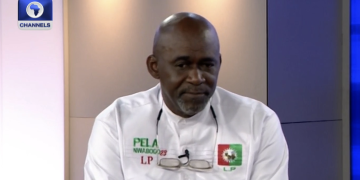




Barr Honesty, Managing Partner at Metrocrest Legal Practitioners, Ikoyi, with close to 2 decades of legal practice shares his thoughts on the requirement to be met by a presidential candidate under section 134 of the 1999 constitution.
The 2023 presidential election in Nigeria is one of the most keenly contested elections in the history of Nigeria in recent times. Statistics have shown that unlike past elections, which had two major contenders, the 2023 presidential election featured a third force which made nonsense of the usual permutations and predictions on the outcome of the election results in Nigeria.
Prior to the election, there were various permutations which predicted a slight probability that none of the three major contestants will secure 25 per cent of the vote in two-thirds of the states – a constitutional requirement for a winner – which is needed to win out rightly. If that happens, it would be the first time the country would see a run-off election. However, as events unfolds the third force in the election caused an upset in the Federal Capital Territory which made it impossible for the candidates of the two major political parties in Nigeria to secure 25 per cent of the vote cast in the Federal Capital Territory (FCT Abuja). This upset has given rise to a major national discourse on the interpretation of section 134 of the 1999 Constitution with various scholars and analysts coming up with their own interpretations of the said section of the constitution. This writer has been inundated with calls from various concerned Nigerians who seek a genuine and unbiased understanding of the law on the interpretation of this section. Hence the need for this write-up.
Section 134 of the 1999 Constitution provides this:
“(1) A candidate for an election to the office of President shall be deemed to have be been duly elected, where, there being only two candidates for the election –
(a) he has the majority of votes cast at the election; and
(b) he has not less than one-quarter of the votes cast at the election in each of at least two-thirds of all the States in the Federation and the Federal Capital Territory, Abuja.
(2) A candidate for an election to the office of President shall be deemed to have been duly elected where there being more than two candidates for the election-
(a) he has the highest number of votes cast at the election;
and
(b) he has not less than one-quarter of the votes cast at the election each of at least two-thirds of all the States in the Federation and the Federal Capital Territory, Abuja.
(3) In default of a candidate duly elected in accordance with subsection (2) of this section there shall be a second election in accordance with subsection (4) of this section at which the only candidate shall be –
(a) the candidate who scored the highest number of votes at any election held in accordance with the said subsection (2) of this section; and
(b) one among the remaining candidates who has a majority of votes in the highest number of States, so however that where there are more than one candidate with majority of votes in the highest number of States, the candidate among them with the highest total of votes cast at the election shall be the second candidate for the election.
(4) In default of a candidate duly elected under the foregoing subsections, the Independent National Electoral Commission shall within seven days of the result of the election held under the said subsections, arrange for an election between the two candidates and a candidate at such election shall be deemed elected to the office of President if –
(a) he has a majority of votes cast at the election; and
(b) he has not less than one-quarter of the votes cast at the election in each of at least two-thirds of all the States in the Federation and the Federal Capital Territory, Abuja
(5) In default of a candidate duly elected under subsection (4) of this section, the Independent National Electoral Commission shall, within seven days of the result of the election held under the aforesaid subsection (4), arrange for another election between the two candidates to which the subsection relates and a candidate at such election shall be deemed to have been duly elected to the office of President, if he has a majority of the votes cast at the election”
Some legal scholars have argued that the above section, especially subsections 134 (1) (b) and (2) (b), are open to two interpretations, they have argued that “two-thirds of all the States in the Federation and the Federal Capital Territory, Abuja” means either of the following: that a presidential candidate must score not less than one-quarter of the votes cast at the election in each of at least two-thirds of all the States in the Federation which means 24 states, the 24 States will include the Federal Capital Territory Abuja as a “State”, or (b) that a presidential candidate must score not less than one-quarter of the votes cast at the election in each of at least two-thirds of all the States in the Federation which means 24 states and in addition to meeting the one-quarter requirement in 24 states, a candidate must also win one-quarter of the votes cast in the Federal Capital Territory, Abuja.
They further argued that “a Presidential candidate must have one-quarter of the votes cast in the Federal Capital Territory, Abuja, in addition to scoring not less than one-quarter of the votes cast at the election in 24 States of the Federation, to be duly elected.
In order to understand the import and purport of sections 134 (1) (b) and (2) (b) of the 1999 constitution, it is expedient to examine the status of the Federal Capital Territory under the law.
THE STATUS OF THE FEDERAL CAPITAL TERRITORY
By virtue of Section 1 of Decree No.6 1976 (now Cap.503 LFN 2004), the over 9,000= sq.km of the area and constituent that is FCT-Abuja was carved out of the former States of Niger, Plateau (now Nasarawa) and Kwara (now Kogi). Effective 4th February 1976. FCT-Abuja ceased to belong or be part of the said former States and assumed a new status and become the seat of the Government of the Federal Republic of Nigeria.
Under the 1999 constitution, Chapter VIII which consists of sections 297 to 304 provides for FCT Abuja. However, the most relevant section to the topic under discourse is Section 299 which provides thus
“The provisions of this Constitution shall apply to the Federal Capital Territory, Abuja as if it were one of the States of the Federation; and accordingly –
(a) all the legislative powers, the executive powers and the judicial powers vested in the House of Assembly, the Governor of a State and in the courts of a State shall, respectively, vest in the National Assembly, the President of the Federation and in the courts which by virtue of the foregoing provisions are courts established for the Federal Capital Territory, Abuja;
(b) all the powers referred to in paragraph (a) of this section shall be exercised in accordance with the provisions of this Constitution; and
(c) the provisions of this Constitution pertaining to the matters aforesaid shall be read with such modifications and adaptations as may be reasonably necessary to bring them into conformity with the provisions of this section.
The above-quoted constitutional provision has been given various judicial interpretations by the Court of Appeal and the Supreme Court in some landmark judgments. In the case of OKOYODE V. FCDA (2005) LPELR-41123(CA) (Pp. 16-19 paras. D), a Full Court’ (5 Justices) of the Court of Appeal held inter alia as follows:
“………….It is therefore doubtless clear that by virtue of Section 299 of the Constitution of the Federation, the Federal Capital Territory is in law a State. In others words, the Federal Capital Territory should be treated as one of the States in the Federal Republic of Nigeria. It follows therefore that bodies like the Federal Capital Development Authority are to be regarded an agency of “a State” independent of the Federal Government”